

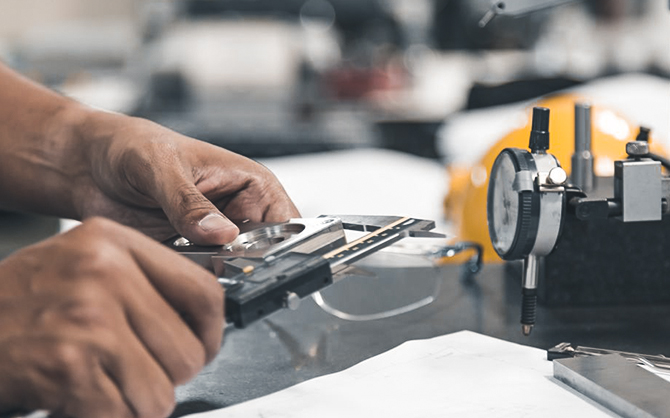
Our lab calibration services are provided with top-notch, imported instruments that are up to date with both international standards and cutting-edge technology.
Why is Calibration So Important?
Calibration defines the accuracy and quality of measurements recorded using a piece of equipment. Over time there is a tendency for results and accuracy to ‘drift’ particularly when using technologies or measuring parameters such as temperature and humidity. To be confident in the results being measured there is an ongoing need to maintain the calibration of equipment throughout its lifetime for reliable, accurate and repeatable measurements. The goal of calibration is to minimise any measurement uncertainty by ensuring the accuracy of test equipment. Calibration quantifies and controls errors or uncertainties within measurement processes to an acceptable level.
◉ Mass & Volume Calibration
◉ Pressure Calibration
◉ Speed & RPM Calibration
◉ Temperature & Humidity Calibration
CALIBRATION TRACEABLE TO NABL STANDARDS
We provide you with the documentation you need to meet your most stringent quality requirements for the control of inspection, measuring, and test equipment. We will calibrate your new or existing instrument traceable to NABL standards.
1. Mechanical Discipline:
A) PRESSURE & VACCUM CALIBRATION
◉ Analogue/ Digital Vacuum Gauge -0 to (-) 0.90 bar
◉ Analogue/ Digital Pressure Gauge -Up to 700 bar
◉ Pressure Transmitter / Switch -0.9 to 700 bar
◉ Magnehelic Gauges- Up to 100mBar
B) MASS & VOLUME CALIBRATION
◉ Weight Set (Class F1 and courser)- 1 mg to 200 g
◉ Loose weights ( Class F2 and courser)- 500 g to 5 kg
◉ Loose weights ( Class F1 and courser)- 500 g to 20 kg
◉ Weighing Balance-1 mg to 100 kg
◉ Micropipette (Fixed/ Multichannel Volume- 10 µl to 10000 µl
◉ Glass Wares - Pipette/ burette/ Flask/Cylinder/ Bottle/ Jar/ Can etc. (Fixed/variable volume)- 1ml to 1000 ml.
C) SPEED & RPM CALIBRATION
◉ Tachometer-Non contact Type- 10 to 90000 rpm
◉ Tachometer- Contact Type- 10 to 3000 rpm
◉ Centrifuge , Shaker- 10 to 20000 rpm
2. Thermal Discipline:
◉ RTD sensor with or without Indicator- (-) 80 °C to 300 °C
◉ Glass / Digital Thermometers & Temperature Gauge- (-) 80 °C to 300 °C
◉ Deep freezer/ Refrigerator/ Cold Chambers / Water Bath (Using Single Point calibration)- (-) 80 to 110 °C
◉ Incubator ( Using Single Point calibration)- 10 to 110 °C
◉ HPLC/GC-MS Temperature Ovens / Shaker Bath/ Liquid Bath- Amb to 250 °C
◉ Muffle furnace- Amb to 1200°C
◉ Thermo Hygrometer (Table Top )/Relative Humidity Probe or Transmitter with sensor- 25 % Rh to 95 % RH @ 25 °C &10 °C to 50 °C @ 50 % RH
◉ Data Logger- 25 % Rh to 95 % RH @ 25 °C&10°C to 50 °C @ 50 % RH
◉ Humidity Calibrator/Generator & Environmental Chamber (Single Point Sensor calibration)- 25 % Rh to 95 % RH @ 25 °C &10°C to 50 °C @ 50 % RH
◉ Autoclave (Temperature Mapping )- 9/ 18 sensor method for various Temp points
◉ Stability Chamber/ walking Chamber/Environmental chamber – Mapping- 9/ 18 sensor method for various Temp points
◉ Deep freezer/ Refrigerator/ Cold Chamber/ Incubator/ Oven -(Temperature Mapping )- 9/ 18 sensor method for various Temp points
◉ Area Mapping (Temperature & Relative Humidity Mapping)- 9/ 18 sensor method for various Temp points.
Calibration Report with test data, including:
◉ Description and identification of the item
◉ Condition of the item as received
◉ Identification of calibration procedure
◉ Calibration date
◉ As found/as left test data
◉ signature of technician
◉ Statement of estimated uncertainty
◉ Test uncertainties (TURs)
◉ List of standards used to perform calibration (including their calibration dates)